How to Restart a Broken Habit Without Starting Over
Why One Missed Day Is Not the Problem (And How to Restart a Broken Habit)
By Tracy Brinkmann
Missing two or three days of a routine often makes restarting feel harder than starting ever did. Somewhere between a skipped afternoon walk and the mental debate that follows, it becomes easy to convince yourself that you need a fresh Monday, a completely redesigned schedule, or a total personality overhaul.
You do not need a new personality to get back on track. Based on insights from Tracy Brinkmann, host of the Your Success DNA podcast, the real challenge isn't building a life that never gets interrupted—because life will always get interrupted. The real skill is stopping a temporary interruption from becoming a permanent exit. Here is how to strip away the guilt, diagnose what actually broke, and build a realistic restart plan on a single piece of paper.
Key Takeaways
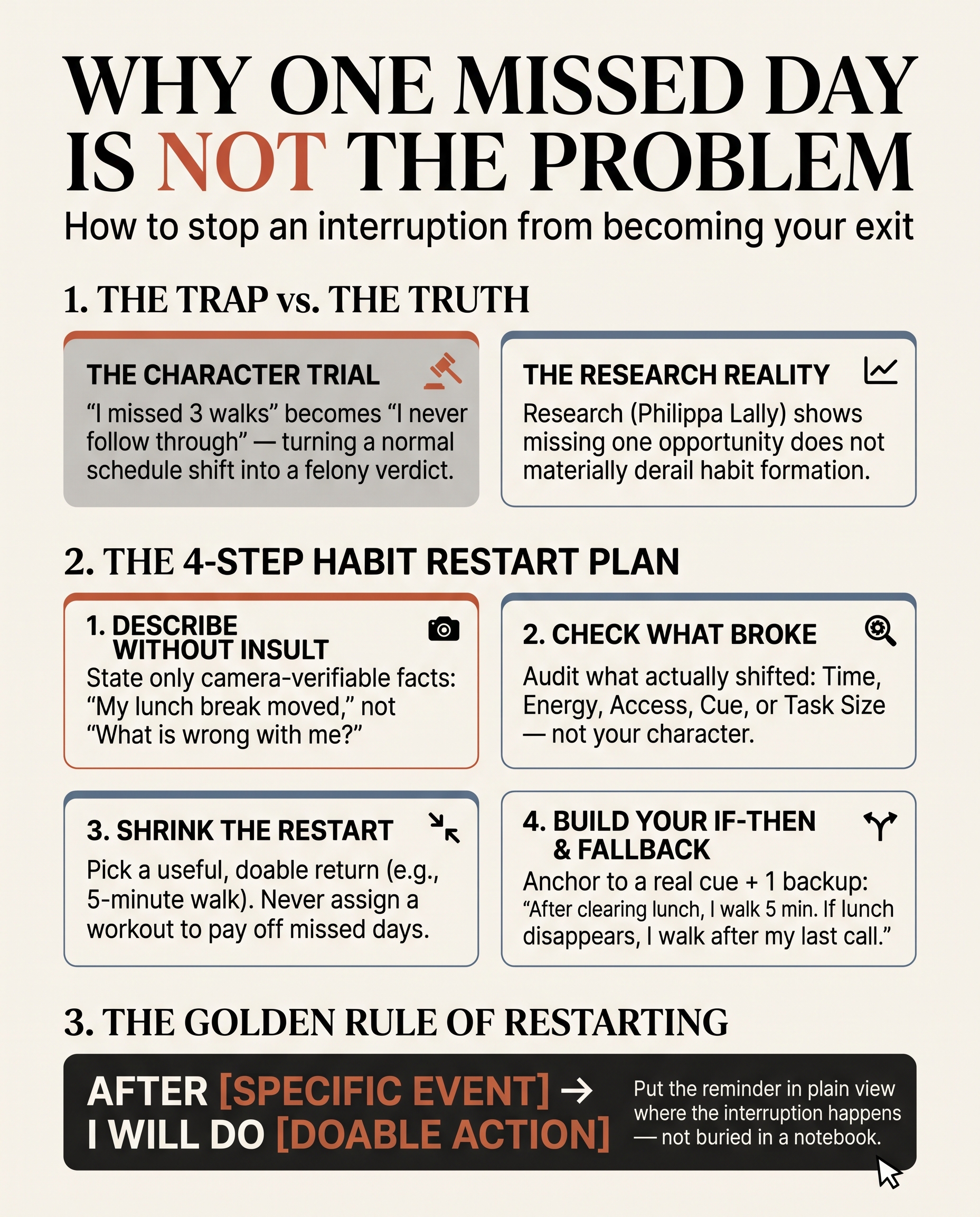
One missed day doesn't erase progress: Research shows that missing a single opportunity does not materially derail the habit-formation process.
Separate facts from character judgments: Describe what happened objectively ("I missed three walks") rather than turning it into an identity flaw ("I never follow through").
Never use guilt as a debt collector: Do not punish yourself with double workouts or extended sessions to "make up" for lost time.
Use implementation intentions: Anchor a smaller, doable version of your habit to a specific daily event ("After I clear my lunch plate, I will walk for 5 minutes").
Build a fallback plan, not an escape hatch: Decide in advance what happens when your primary window disappears, and place that reminder where the disruption occurs.
Separate What You Missed From What You Decided It Means
When a routine gets derailed—such as an after-lunch walk disappearing during a chaotic week—the biggest obstacle to restarting is rarely physical. It is the story you tell yourself about the interruption.
There is a massive difference between stating a fact ("I missed three walks on Tuesday, Wednesday, and Thursday") and passing a character verdict ("I never follow through"). The first sentence describes a scheduling disruption; the second puts your entire personality on trial.
To stop spiraling, describe the interruption using only facts that a phone camera could verify. Avoid absolute words like always, never, or every single time.
-
Subjective judgment: "I'm terrible at sticking to routines."
-
Camera-verifiable fact: "My lunch break moved because of meetings, and I haven't walked since Monday."
This perspective aligns with habit-formation research by psychologist Philippa Lally and her colleagues. In their study of volunteers repeating daily eating, drinking, or activity behaviors, missing a single opportunity did not materially affect the overall habit-formation process. While long interruptions certainly have an impact, one or two missed days do not wipe out the foundation you already built.
Diagnose What Actually Broke Before Shrinking the Goal
Before you assume you need more willpower or a smaller habit, look closely at what caused the interruption. Not every broken routine requires a tiny goal; sometimes it simply requires a different schedule, accessible gear, or physical recovery.
As Tracy Brinkmann points out, a skipped afternoon walk can stem from five completely different problems:
-
Schedule shifts: Meetings overlapped your lunch break, erasing your usual time window.
-
Environment and access: Unsafe weather hit, or your walking shoes were locked in the back of your car during a downpour.
-
Energy and health: You were fighting off an illness, recovering from an injury, or depleted from caregiving duties.
-
Scope creep: A simple 15-minute walk quietly morphed into a 45-minute production requiring specific gear and a curated playlist.
-
Shifting priorities: The original purpose of the habit no longer fits your current season of life.
Ask yourself one straightforward question: What did this habit depend on that I don't reliably have available right now? Whether the missing piece is time, energy, equipment access, or a reliable cue, identify the most obvious bottleneck and repair that specific variable. Furthermore, check in on whether you still want the underlying benefit of the habit—such as a quiet mental break or unwinding before bed. A routine written in a notebook does not get a permanent vote over your current reality; if a goal no longer serves you, you are allowed to cross it out.
Design a Realistic Restart (Without the Guilt Tax)
Once you confirm that the habit still matters to you, separate what you want the habit to look like eventually from what you are agreeing to do next.
If your long-term goal is a 20-minute daily walk, your immediate restart might be a 5-minute walk around the block. The goal isn't to pick a number that sounds clever; it is to pick a useful, realistic action that serves the habit's core purpose and fits inside your current week.
Crucially, do not confuse a penalty with a plan. When you miss three 20-minute walks, it is tempting to demand a 60-minute walk to "pay off" the deficit. Turning a supportive routine into a debt collector creates resentment and teaches your brain that restarting is painful. Keep your agreement clear and bounded:
-
Define what counts: Agree in advance that 5 minutes of walking, reading one focused page, or practicing a single difficult bar of music counts as a complete win.
-
Stop when the agreement ends: Give yourself permission to stop at 5 minutes. If you have the energy to keep going, great—but never attach an undisclosed extension to a small restart.
-
Don't substitute preparation for action: Putting your shoes by the door supports the habit, but organizing your bookshelf or buying new gear is not the same thing as reading or walking.
Give Your Habit an Address With Implementation Intentions
Saying "I'll get back to it" is a wish, not a plan. To turn that wish into action, borrow a framework from psychologist Peter Gollwitzer known as implementation intentions. Instead of relying on motivation, you link a specific situation to a specific behavior using a simple formula:
"After [specific, reliable event], I will [specific, doable action]."
For example: "After I put my lunch plate in the dishwasher tomorrow, I will put on my shoes and walk for 5 minutes."
Make sure the anchor event actually happens reliably. If your workday is unpredictable, "tomorrow at noon" is a weak trigger, whereas "after my first meal at home" is unmistakable. Avoid vague triggers like "after things calm down"—that is a forecast for a day that rarely arrives. Double-check the basic logistics beforehand so you aren't wasting your five-minute window hunting for a missing shoe.
Give Your Next Interruption a Job Description
Most habit plans fail because they are built for an ideal week rather than an actual Tuesday. Instead of hoping your schedule stays clear, build a fallback plan for the exact moment your primary opportunity disappears.
Be careful not to confuse a fallback plan with an escape hatch:
-
An escape hatch says: "If anything gets in the way, I'll get back to it sometime."
-
A fallback plan says: "If a meeting consumes my lunch break, I will take my 5-minute walk immediately after my last afternoon call."
Stick to one clear fallback rather than creating a menu of twelve backup options. If an unexpected emergency wipes out the entire day, your fallback plan can simply be naming the next specific decision point—such as reviewing your schedule after breakfast the next morning—rather than cramming a workout in at midnight out of guilt.
Place the Plan Where the Disruption Happens
A fallback plan buried on page 30 of a closed notebook is just home decor. Move the decision out of storage and into plain view by placing a short visual reminder right where you will first notice that your original plan broke.
If your lunch break tends to get swallowed by back-to-back calls, put a brief note near your workspace or lunch setup: "Lunch disappeared? 5-minute walk after last call." Keep it short enough to read in a single glance, and if your routine relies on a partner or family member, share the fallback plan with them so everyone is on the same page.
Frequently Asked Questions
Does missing one day ruin a habit?
No. Habit-formation research conducted by Philippa Lally and her colleagues found that missing a single opportunity does not materially affect the long-term habit-building process. The real danger isn't the missed day itself, but the all-or-nothing mindset that convinces you to abandon the routine entirely.
How do I get back on track after breaking a habit streak?
Write down what happened in one objective sentence without judging yourself, check what changed in your schedule or environment, and commit to a smaller, realistic version of the habit. Anchor that action to a reliable daily event—such as right after clearing a meal—rather than waiting for a fresh week to start.
Should I do a longer workout to make up for missed days?
No. Trying to "pay back" missed days with double sessions turns a supportive habit into a punishment. Stick to a small, clearly defined restart action (like a 5-minute walk) so your brain associates returning to the habit with success rather than dread.
What is the difference between a fallback plan and an escape hatch?
An escape hatch is a vague promise to resume a habit "when things calm down" or "later." A fallback plan is a pre-decided, specific alternative triggered by a disruption—for example, shifting a missed lunchtime walk to immediately after your final afternoon meeting.
Your One-Minute Habit Reset
You do not need a spotless winning streak to prove you are serious about your goals. Pick just one habit you want to return to right now, grab an ordinary piece of paper, and write down three things:
-
Your next realistic opportunity (the specific anchor event)
-
One doable version of the action (small enough to finish without friction)
-
Your single fallback plan (what happens if that window disappears)
Put that piece of paper somewhere you will actually see it today, and let your next small action do the talking.
This article is adapted from insights shared by Tracy Brinkmann on the Your Success DNA podcast. Watch or listen to the full episode on YouTube:
Why Capable People Always Say Yes (And How to Stop)