The Dark Side of Biohacking: Is Your Routine Toxic?
The Dark Side of Biohacking: Why Your Routine Might Be Destroying You
By Tracy Brinkmann
TL;DR
Obsessive self-optimization and extreme biohacking can transform healthy habits into sources of chronic anxiety, isolation, and burnout. As demonstrated by high-profile protocols like Bryan Johnson’s Project Blueprint, tracking every biomarker often replaces genuine well-being with perfectionism. True long-term health and longevity depend far more on authentic human relationships and internal balance than on rigid routines or flawless habit scores.
Every morning, millions of high achievers wake up to an invisible scorecard. They review sleep scores, log supplements, meditate against a timer, and strive to execute the "perfect" morning routine. But what happens when the relentless pursuit of peak performance turns into a trap?
Self-improvement is designed to create freedom, yet an extreme focus on optimization frequently produces the exact opposite: shame, exhaustion, and physical breakdown. Understanding where healthy routines cross into self-destruction begins with examining the most extreme biohacking experiment ever documented.
📌 Key Takeaways
The Optimization Paradox: Approaching health metrics with perfectionism triggers chronic stress, shame, and burnout instead of vitality.
Clinical Fixations: Wearables and wellness media can fuel recognized disorders like orthosomnia (anxiety over sleep data) and orthorexia (obsessive clean eating).
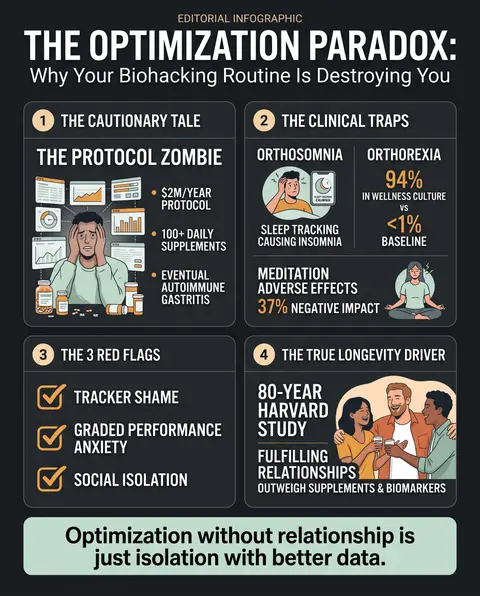
Meditation Adverse Effects: Up to 58% of mindfulness participants report negative effects such as anxiety, time-space distortions, or traumatic re-experiencing.
The Human Metric: An 80-year study revealed that fulfilling relationships—not biological metrics, supplements, or wealth—are the single greatest predictor of human longevity.
The $2 Million Cautionary Tale: When "Running Code" Fails
In 2013, tech entrepreneur Bryan Johnson sold Braintree (the payment platform behind Venmo) to PayPal for $800 million. Despite immense financial success, Johnson faced profound personal challenges, including severe depression, a divorce, and leaving his faith community.
Seeking control, he turned to engineering principles and data. In 2021, he launched Project Blueprint, an intensive anti-aging protocol designed to reverse biological age through total algorithmic control:
-
Consuming his final meal of the day by 11:00 AM.
-
Taking over 100 supplements daily.
-
Sleeping completely alone and undergoing recurring MRIs, hyperbaric oxygen therapy, micro-needling, and full-body red-light exposure.
-
Viewing himself as an "algorithmic organism" focused on "running the code of health" based purely on biomarkers rather than subjective feeling or comfort.
The Systemic Cracks Begin to Show
Despite global attention, the physical and emotional costs mounted:
-
Discarded Therapies: In 2023, Johnson discontinued blood plasma exchanges performed with his son after data demonstrated no measurable anti-aging benefit.
-
Severe Isolation: Johnson publicly admitted that his rigid routine made romantic relationships essentially impossible. Meanwhile, documentary footage captured his son moving away for college, leaving Johnson alone in a sterile, hyper-monitored home.
-
Autoimmune Breakdown: In 2026, Johnson was diagnosed with autoimmune gastritis—a condition where the immune system attacks the stomach lining. Following the diagnosis, he publicly questioned the extremes of Project Blueprint, referencing limits and the need to reconsider.
-
Expert Warnings: Longevity researcher Dr. Nir Barzilai (Director of the Institute for Aging Research at the Albert Einstein College of Medicine) had previously cautioned that several of Johnson’s simultaneous treatments actively antagonized one another, cautioning that it departed from sound clinical and scientific experimental practices.
The Everyday Trap: How Micro-Optimization Breaks the Brain
You do not need an $800 million exit or a $2 million annual budget to experience the psychological toll of hyper-optimization. Everyday tools—such as habit-tracker streaks, strict morning protocols, and wellness feeds—can quietly generate destructive habit loops.
When individuals fall short of an idealized regimen, the resulting guilt often mimics the very stress they sought to eliminate.
       [ Idealized Protocol ]
         (Wearables / Streaks)
                 │
                 ▼
       [ Perfectionist Tracking ]
         ("Running the Code")
                 │
                 ▼
       [ Data-Induced Anxiety ]
     (Orthosomnia / Orthorexia)
                 │
                 ▼
    [ Burnout & Biological Strain ]
   (Immune & Circadian Disruption)
Dr. Kylee Bobnet, a physician studying the neurological costs of relentless self-improvement, highlights this core paradox: tracking is often adopted to enhance performance, but when the relationship with that data becomes punitive, the net outcome is increased stress, shame, and vulnerability to depression.
Recognized Manifestations of Optimization Anxiety
-
Orthosomnia: A clinical phenomenon where users develop severe anxiety specifically regarding their sleep tracker scores. Fixating on low readiness or recovery metrics spikes cortisol and disrupts the circadian rhythm, actively ruining sleep quality.
-
Orthorexia: An obsessive fixation on clean or "pure" eating. While orthorexia affects less than 1% of the general population, a cited social media study revealed that 94% of people who follow health-food accounts showed symptoms. The wellness content itself frequently catalyzes the dysfunction.
The Undiscussed Risks of Mindfulness Protocols
Mindfulness meditation is widely promoted across digital health platforms, yet clinical literature documents a significant prevalence of adverse reactions that rarely make headline content.
-
High Incidence of Adverse Events: Research indicates that approximately 58% of participants in structured mindfulness programs (such as Mindfulness-Based Stress Reduction [MBSR] and Mindfulness-Based Cognitive Therapy [MBCT]) experience at least one adverse reaction. Broader literature estimates adverse effects between 25% and 87%.
-
Functional Impairment: Around 37% reported negative impacts on daily functioning, with 3% to 37% experiencing operational impairment that interfered with basic daily duties.
-
Documented Side Effects: Reported symptoms include heightened anxiety, depersonalization, time-space distortions, and the traumatic re-experiencing of past events. In intensive retreat settings, practice has occasionally triggered psychotic or delusional episodes.
-
Youth Well-Being Trials: An £8 million Wellcome Trust study evaluating over 8,000 students across 84 UK schools demonstrated that school-based mindfulness interventions failed to improve mental well-being compared to control groups, and potentially worsened outcomes for students already vulnerable to mental health issues.
Dr. Willoughby Britton of Brown University notes that individuals frequently turn to meditation to resolve existing suffering, double down when quick fixes fail to materialize, and inadvertently turn the practice into an additional source of distress.
Silicon Valley and the Epidemic of "Shadow Burnout"
The modern biohacking ethos emerged directly from tech culture, where relentless work demands are increasingly packaged as personal development.
| Metric / Phenomenon | Recorded Impact |
| Entrepreneur Mental Health | 72% report mental health concerns (vs. 49% in control groups), with double the rate of depression and 10x the rate of bipolar diagnoses (Stanford/UC Berkeley). |
| Shadow Burnout | 73% of tech founders continue hitting quarterly performance targets while physical and emotional health quietly disintegrates. |
| Workplace Strain | 70% struggle with sleep disruptions; 45% report damaged or strained personal relationships. |
| Global Workforce Disengagement | 80% of employees are disengaged globally, driving $438 billion in lost productivity. |
| Regional Burnout Surges | 68% of Gen Z workers in Singapore (2024); 50% of Australian workers (2024–2025). |
Following widespread tech layoffs starting in 2023, high-pressure norms like the "9-to-9" work schedule (9:00 AM to 9:00 PM, six days a week) entered Western startup cultures. Bay Area clinicians observed that conversations surrounding wellness and psychological safety vanished almost overnight, replaced once again by aggressive grind culture.
The Ultimate Predictor of Longevity: Relationships Over Regimens
In my view, treating your daily routine like a machine calibration inevitably strips away the spontaneity that makes living worthwhile.
The tragic irony of extreme biological tracking is the neglect of the single most validated longevity factor in modern science. An 80-year adult development study demonstrated that happy, fulfilling relationships—not genetics, IQ, social class, or dietary supplements—are the greatest predictors of a long, healthy life.
You cannot substitute social intimacy with physical optimization. As Johnson himself gradually re-engaged with personal relationships—acknowledging his partnership with Kate Kolo in 2025—it became evident that authentic human connection provides psychological resilience that biomarkers can neither quantify nor replace.
"Optimization without relationship is just isolation with better data."
— Tracy, Your Success DNA
How to Rebalance Your Approach to Health
Building a sustainable, healthy routine does not mean abandoning personal growth, physical exercise, or structured habits. The critical variable is your psychological relationship to those practices:
-
Audit Your Emotional Response to Data: If an uncompleted habit tracker triggers failure or self-loathing, pause the app. The metric should inform self-awareness, not dictate personal worth.
-
Beware Inhuman Standards: Burnout is often not a failure of willpower or discipline, but a predictable biological response to impossible expectations imposed upon oneself.
-
Prioritize Human Connection: Do not compromise dinners with family, casual conversations with friends, or moments of intimacy simply to meet an arbitrary sleep window or supplementation deadline.
Before bed tonight, skip the complex evening stack. Send a genuine message to a friend, partner, or family member you may have sidelined in the name of productivity. Let them know you care—without an agenda or transactional expectation.
Frequently Asked Questions
What is the dark side of biohacking?
The dark side of biohacking refers to the psychological and physiological hazards of obsessive health optimization. When self-tracking turns into perfectionism, it frequently leads to severe stress, social isolation, clinical conditions like orthosomnia or orthorexia, and paradoxical physical decline.
What is orthosomnia?
Orthosomnia is a sleep disorder driven by anxiety surrounding sleep data. Individuals become so preoccupied with obtaining optimal readiness, deep sleep, or REM metrics on wearable devices that the resulting anxiety disrupts their natural circadian rhythms and prevents restful sleep.
Can mindfulness meditation cause negative side effects?
Yes. Clinical studies, including research by Dr. Willoughby Britton, reveal that between 25% and 87% of mindfulness practitioners encounter adverse effects. The most frequent issues include acute anxiety, derealization, time-space distortion, and re-traumatization.
What is the single biggest factor for longevity?
According to a landmark 80-year study, warm and fulfilling relationships are the greatest predictor of long-term health and longevity—outperforming genetics, IQ, wealth, and supplementation regimens.
Source & Credits
This article is based on insights, analysis, and research presented by the Your Success DNA podcast in the episode
The Dangerous Reality of the Gateway Process