Why Capable People Always Say Yes (And How to Stop)
Why Capable People Always Say Yes (It’s Not What You Think)
TL;DR
Capable people often agree to requests not out of true desire, but because an automatic "yes" reflex operates faster than their schedule or energy can keep up. Every unexamined commitment quietly drains your reserves and breeds resentment that ultimately spills over onto those you love. By introducing a deliberate pause—using simple scripts to buy time, evaluating your capacity against core values, and tolerating the temporary sting of guilt—you can protect your energy and ensure your yeses actually mean something.
-----------------------------------
by Tracy Brinkmann
You know the feeling: someone asks, "Hey, could you take care of this?" Before you even realize what has happened, your mouth answers, "Sure, no problem." Your calendar wasn't checked, your energy wasn't weighed, and your brain showed up several seconds late to inspect a contract you already signed.
Later that night, you find yourself stuck handling the task—quietly frustrated with them, annoyed with yourself, and running on fumes.
This is not the cartoon version of people pleasing where someone acts like a passive doormat. This is the capable version: the dependable person everyone leans on, who says yes simply because they can, only to end up depleted.
Being helpful is admirable, but an automatic yes comes with a hidden bill. Here is why high-capacity individuals fall into the reflex trap, what it actually costs, and how to protect your time and energy without losing your kindness.
Key Takeaways
Speed is the Culprit: The issue is not saying yes; it is the reflex speed of the response before your brain consults your calendar or energy levels.
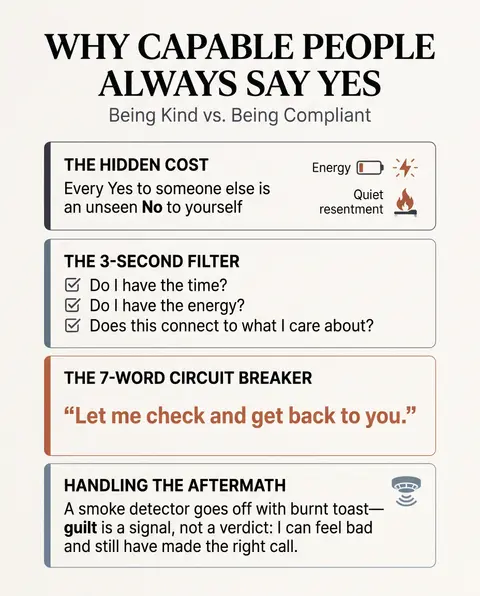
Every Yes Hides a No: Committing time to one task automatically deprives another priority, whether that is rest, family, or health.
Resentment Signals Mismatch: Resentment acts as an internal alarm showing you agreed with your words to something your mind rejected.
The Pause Breaks the Habit: A simple seven-word delay—"Let me check and get back to you"—creates the breathing room needed to assess capacity.
Guilt Is Not a Verdict: Feeling uncomfortable after declining does not mean you made the wrong choice; it simply means setting boundaries is new.
The Trap of the "Automatic Yes"
The fundamental issue is not the commitment itself—it is the speed of the agreement. A considered yes is a genuine gift, but an automatic yes is merely a reflex, and reflexes never check your schedule.
Consider "Dana," a composite example of a high achiever many of us recognize. Dana is excellent at her job, coordinates family holidays, volunteers for the school fundraiser, and somehow took on chauffeuring a neighbor's child twice a week. Nobody coerced her; people asked nicely, and she reflexively agreed. In the abstract, Dana knows she is stretched thin, but in person, a hopeful agreement slips out before she can evaluate the request.
Two psychological mechanisms drive this split-second reaction:
-
Catastrophizing Social Fallout: We instinctively predict that declining will offend the requester, make us look uncaring, or permanently damage the relationship.
-
Identity Confusion: Reliable individuals identify strongly with being helpful. However, being helpful quietly morphs into being always available—two completely different job descriptions.
Research shows our fears of declining are frequently exaggerated. A 2024 study by Julian Givi and Colleen Kirk in the Journal of Personality and Social Psychology examined people turning down social invitations (such as lunches or sporting events). The researchers found that invitees consistently overestimated how upset, offended, or reluctant to invite them in the future the inviters would be. In reality, inviters placed far more weight on the thought and consideration behind the response than on the refusal itself. While workplace or familial contexts carry their own stakes, our internal worst-case scenarios typically oversell the negative fallout.
The initial step forward is purely observational: notice the physical urge to agree instantly. You cannot steer a habit you do not catch.
The Hidden Cost: The Water and the Well
Time and personal energy obey finite constraints. Just as water diverted to one field cannot irrigate another, every commitment you make quietly forces a refusal elsewhere.
When you agree to run an errand you lack bandwidth for, you are silently saying no to a workout, preparing a meal without stress, or enjoying twenty minutes of quiet downtime. Because that trade-off remains invisible, the cost is easily overlooked.
       [ Finite Personal Capacity ]
             /              \
     Explicit "YES"     Hidden "NO"
    (School Event,      (Rest, Family,
     Extra Shift)        Personal Time)
           \                 /
            [ Latent Resentment ]
When you continually leave yourself out of the equation, the result is resentment. Resentment is the emotional receipt for agreeing to terms your mind never endorsed.
Worse, that irritation rarely stays contained:
-
You become short with your family later that evening.
-
You act cold toward the person who asked, even though they have no idea why.
-
The reflex agreement delays the unkindness, ultimately redirecting it at people who had nothing to do with the request.
Psychologists Vicki Helgeson and Heidi Fritz identified this dynamic as unmitigated communion—the tendency to care for others to the complete exclusion of the self. Their research demonstrates that caring for others is healthy; it is the total omission of one's own basic needs that leads to profound emotional distress. Caring is not the issue—leaving yourself off the ledger is.
3 Questions to Ask Before You Commit
Setting vague boundaries ("I need to say no more often") rarely works when put on the spot. To evaluate incoming requests objectively, run them through three specific filters:
-
Do I have the actual time? (Not: can I cram it into my day if I sacrifice two hours of sleep?)
-
Do I have the energy? (A task might fit on your calendar grid while exceeding what remains in your emotional tank.)
-
Does this connect to something I genuinely value?
The goal is not to eliminate agreements; the goal is to protect agreements that carry real meaning.
For instance, if Dana’s sister needs assistance recovering from surgery, Dana might agree despite feeling exhausted because family support is a core value. That is not people pleasing; that is an intentional, conscious sacrifice. By contrast, running a school committee out of fear of social judgment yields the exact same expenditure of energy without any of the alignment.
If your honest assessment reveals you have both the time and energy but simply do not want to participate, that alone is valid. You do not need an external justification to pass.
Scripts to Reclaim Your Time
When someone asks for your time, you do not need to deliver an immediate verdict. You need a buffer.
1. The Pause Script
"Let me check and get back to you."
In drumming, the rests between notes create the groove; rushing past them ruins the rhythm. This seven-word phrase acts as a conversational rest. It commits you neither to a yes nor a no—it simply breaks the reflex, giving your intellect time to consult your schedule and evaluate your energy.
2. The Direct, Warm Decline
"Thanks for thinking of me. I can't take that on right now."
Avoid five-paragraph rationalizations or manufactured excuses. Lengthy explanations inadvertently invite the other person to problem-solve your schedule, turning a clear boundary into a negotiation.
3. The Scaled-Back Alternative
"I can't run the full committee, but I can drop off supplies on Friday."
Offer a partial contribution only if you genuinely want to help in that smaller capacity.
4. The Reset for Existing Commitments
"I agreed to take this on, but I realize I cannot sustain it well. I wanted to give you enough notice so you can plan accordingly."
Revisiting an unsustainable commitment is not breaking trust; it is showing integrity before burnout and resentment damage the relationship.
(Note: These scripts are designed for everyday social and professional interactions. If you find yourself in a dynamic where saying no poses an immediate threat to your safety or livelihood, seek direct guidance from a qualified professional or trusted support system.)
Taming Post-Boundary Guilt
You can deliver a refusal with total warmth and clarity, only to have guilt arrive an hour later: Was that selfish? Are they furious with me? Should I fix it?
Guilt is an internal smoke detector. A smoke alarm sounds when toast burns, but that does not mean the house is on fire. When you have operated on reflex compliance for years, setting a boundary will naturally feel unnatural. That discomfort does not signal wrongdoing; it simply indicates novelty.
Keep this anchor phrase in mind when self-doubt surfaces:
"I can feel uncomfortable and still have made the right call."
Both realities can coexist. You can empathize with someone's disappointment without assuming responsibility for resolving it. Avoid the temptation to villainize the person who asked to justify your decision; people are entitled to ask, and you are equally entitled to decline.
How to Ask Without Trapping Others
If you want others to respect your boundaries, make it effortless for them to set their own.
Well-intentioned statements like "You're the only one who can handle this" or "I know I can always count on you" can inadvertently corner capable people. Instead, build an explicit exit into your requests:
-
"Are you open to helping with this project? Totally fine if your plate is full."
-
"Could you take this on? If the timing is bad, just let me know and I'll find another route."
When they decline, accept it graciously without sighing, subtle guilt-tripping, or martyr comments. When you normalize a safe "no," the "yeses" you receive become vastly more meaningful.
Frequently Asked Questions
Why do capable, reliable people struggle the most with people pleasing?
Capable people are accustomed to succeeding under pressure and frequently tie their personal identity to being helpful and dependable. Because they possess the skill to solve problems, they confuse having the capacity to help with an obligation to be continually available.
What is unmitigated communion?
Identified by researchers Vicki Helgeson and Heidi Fritz, unmitigated communion is an interpersonal orientation where an individual focuses on others to the complete exclusion of their own needs. It is this systematic self-neglect—rather than kindness itself—that correlates with heightened distress and burnout.
How do I decline an invitation without sounding rude?
Express appreciation, deliver the refusal clearly, and avoid over-explaining. A phrase such as "Thanks for thinking of me, but I can't take that on right now" establishes a firm boundary while maintaining a polite, respectful tone.
What should I do if I already said yes to something I regret?
Reach out proactively and communicate honestly: "I agreed to take this on, but I've realized I cannot sustain it well. I wanted to give you notice so you have time to make alternate plans." Addressing the mismatch early prevents resentment from eroding the relationship.
Reclaim Your Yes
Breaking the automatic yes does not require an overnight overhaul of your personality. The objective is never to become cold or unapproachable—communities thrive on reliable people who show up. The goal is simply to reclaim the half-second pause between an ask and your reply.
Start small this week: identify one recurring situation where you tend to agree automatically. When the request arrives, catch the reflex, use the pause, assess your energy, and offer an answer that reflects what you can sustainably give.
This article was adapted from the insights shared by Tracy on the
The Dark Side of Biohacking: Is Your Routine Toxic?