The Dangerous Reality of the Gateway Process
The Dangerous Reality of the Gateway Process: What the Military Really Uncovered
By Tracy Brinkmann
TL;DR
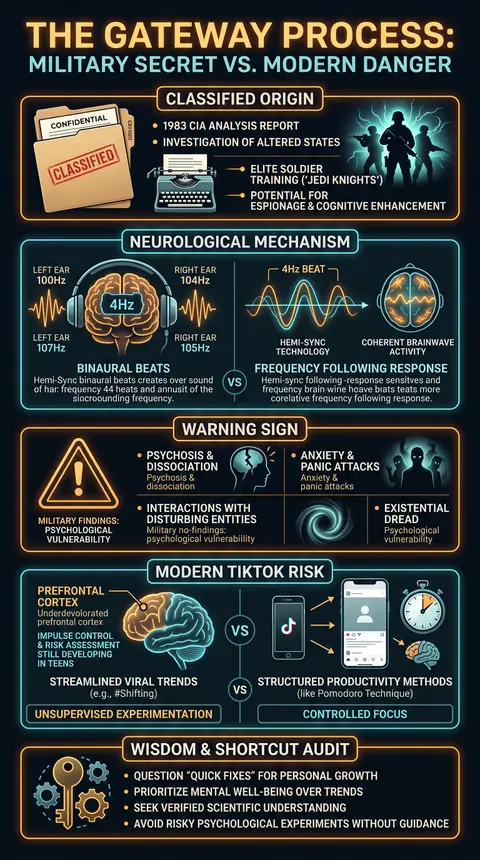
In 1983, a classified U.S. Army analysis evaluated the "Gateway Process"—a sound-based technique designed to synchronize brainwaves and alter human consciousness. While elite operatives demonstrated accelerated learning and remote viewing capabilities, the military ultimately shelved the initiative due to severe psychological instability and uncontrollable risks. Today, viral trends on social media promote these same frequencies as productivity shortcuts, ignoring the danger of attempting to force rapid neuroplasticity without foundational discipline.
Key Takeaways
-
Declassified Military Origins: In 1983, Lt. Col. Wayne M. McDonnell authored a 29-page assessment titled Analysis and Assessment of Gateway Process for the U.S. Army Operational Group at Fort Meade.
-
The Mechanics of Hemi-Sync: Based on H.W. Dove’s 1839 discovery of binaural beats, radio executive Robert Monroe developed and patented "Hemi-Sync" in 1975 to elicit the brain’s frequency-following response.
-
Observed Operative Benefits: Selected soldiers in the Trojan War Project (dubbed "Jedi Knights") mastered Russian faster, shot more accurately, and regulated stress under pressure.
-
Severe Psychological Fallout: The program was abandoned because participants faced debilitating risks, including shadow figures, acute dread, persistent nightmares, and severe mental distress.
-
Viral Dangers vs. Sustainable Growth: Young experimenters online use these tapes seeking instant transformation, contrasting with safe, structured cognitive frameworks like the Pomodoro Technique.
What Is the Gateway Process?
During the height of the Cold War, paranoia over Soviet psychic advancements spurred American intelligence agencies to explore human consciousness as a strategic weapon. In June 1983, a 29-page report by Lieutenant Colonel Wayne M. McDonnell was delivered to the commander of the U.S. Army Operational Group at Fort Meade, Maryland.
Titled Analysis and Assessment of Gateway Process, this document laid out a structured framework for altering human perception, transcending conventional space-time limits, and weaponizing cognitive states.
The roots of the system trace back to Robert Alan Monroe, an Indiana-born radio executive who began experiencing out-of-body experiences (OBEs) in 1958. Monroe obsessively documented these phenomena, publishing Journeys Out of the Body in 1971. Monroe was not content with merely observing these events; he wanted to engineer them predictably.
+-------------------------------------------------------+
|                 Hemi-Sync Mechanism                  |
|                                                       |
|  Left Ear Tone (e.g., 200 Hz)                         |
|  Right Ear Tone (e.g., 207 Hz)                        |
|                                                       |
|  ---> Neurological Response: Difference (7 Hz)        |
|  ---> Frequency Following Response (Brainwave Shift) |
|  ---> Hemispheric Synchronization                     |
+-------------------------------------------------------+
The Science of Hemispheric Synchronization (Hemi-Sync)
Monroe’s tool of choice was Hemi-Sync (short for hemispheric synchronization), patented in 1975. Its foundation relied on binaural beats, first identified in 1839 by German scientist H.W. Dove.
-
Binaural Beats: When two distinct acoustic frequencies enter each ear independently through headphones, the brain reconciles the offset by generating a third internal signal equal to the mathematical difference.
-
Frequency Following Response: Because this third signal is an electrical event across both brain hemispheres, the brain naturally synchronizes its rhythms to match the stimulus.
-
Monroe's Focus Levels: Monroe layered audio frequencies to steer brain activity into distinct benchmarks:
-
Focus 10: "Mind awake, body asleep."
-
Focus 12: Expanded spatial awareness.
-
Focus 15: A non-linear temporal state where conscious linear time dissolves.
-
By 1977, the Monroe Institute ran its first civilian Gateway program, drawing immediate scrutiny from military leaders operating under Project Stargate.
The "Jedi Knights" and Project Stargate
Working alongside physicists Russell Targ and Harold Puthoff at SRI International, the Defense Intelligence Agency (DIA) set out to validate whether intuitive phenomena like remote viewing held genuine utility.
Within the Army's "Trojan War Project," a cohort of 25 elite soldiers subjected themselves to the Gateway framework. These soldiers, humorously adopting Latin-inscribed "May the Force be with you" shirts, became known internally as the Jedi Knights.
The military's internal files noted significant biometric and performance enhancements:
-
Neurological & Muscular Control: Measurable gains in biofeedback self-regulation.
-
Accelerated Competence: Faster acquisition of foreign languages (such as Russian) and rapid mastery of complex weapons systems.
-
Enhanced Marksmanship: Sharper focus and improved shooting accuracy.
-
Operational Stability: Unusually high composure under simulated combat pressure.
Key operatives highlighted the program's perceived value. Joseph McMonagle, designated as "Remote Viewer 001," served for over a decade with contract renewals backed by notable hit rates. In 1989, operative Angela Dellafiora Ford was tasked with locating an escaped customs officer; she marked a location in Lowell, Wyoming, and the fugitive was subsequently apprehended 100 miles west in Lovell, Wyoming.
Why the Military Abandoned the Program
Despite measurable gains, the Department of Defense concluded that the Gateway Process was unsuitable for deployment. In 1995, an independent evaluation by the American Institutes for Research determined that remote viewing generated intelligence that was far too ambiguous and erratic to inform real-time tactical decisions.
Beyond inconsistencies, an unpublicized factor tipped the scales: the psychological toll was catastrophic.
Unsupervised and sustained journeys through Monroe's focus levels brought severe side effects to test subjects:
-
Experiences with terrifying "shadow figures" and perceived dark entities.
-
Persistent, debilitating nightmares and daytime paralysis.
-
Overwhelming, uncontrollable dread, depression, and psychosis.
-
Documented warnings of lasting physical distress and what records described as "spiritual degradation."
Recognizing that the protocol could destabilize the minds of trained personnel, the program was terminated.
Modern Risks: TikTok and Forced Neuroplasticity
In 2003, the CIA declassified the McDonnell report. Years later, between 2020 and 2021, communities across TikTok and online forums unearthed the archive. Young users began circulating ripped audio files under hashtags like #gatewaytapes and #astraltravel, attempting to trigger rapid out-of-body travel and accelerated productivity.
This modern trend overlooks basic neurobiology:
-
Forced vs. Natural Rhythms: Safer cognitive frameworks like the Pomodoro Technique (developed by Francesco Cirillo) match work periods to the body's natural 90-minute ultradian cycles and finite 20- to 25-minute attention spans. The Gateway Process, by contrast, forces brainwave shifts through sustained acoustic override.
-
Developing Frontal Lobes: As neuroscientific consensus confirms, the human prefrontal cortex—the region responsible for impulse control and discipline—continues maturing until age 25. Introducing unmonitored altered states to an adolescent brain risks aggravating existing emotional vulnerabilities.
-
Auditory Illusion vs. True Expansion: Dr. Maria Chait, an auditory cognitive neuroscientist at University College London, notes that binaural beats induce an unfamiliar acoustic illusion. The subjective intensity of the sensation frequently leads listeners to assume profound spiritual breakthroughs, regardless of objective underlying changes.
+---------------------------+-----------------------------------+
| Pomodoro Framework       | Gateway Process Tapes             |
+---------------------------+-----------------------------------+
| Aligns with natural focus | Artificially forces brainwave     |
| and ultradian cycles      | states via external audio pulses  |
| Incremental neuroplastic  | Aims to bypass baseline mental    |
| adaptation                | adaptations overnight             |
| Zero psychological risk   | Documented risk of psychosis,     |
| profile                   | disorientation, and severe dread  |
+---------------------------+-----------------------------------+
The Illusion of the Shortcut
The allure of the Gateway Process lies in the promise of an unearned leap forward. When a classified document describes rapid skill acquisition, people naturally look for a way to circumvent ordinary practice.
In my view, chasing an unvetted military mental hack usually points to foundational work being neglected elsewhere.
Real cognitive improvement is rarely sudden. Research from Ruhr-University Bochum shows that chronic procrastination correlates with an enlarged amygdala, highlighting a conflict between emotional impulses and executive planning. Overcoming that friction requires repetitive, day-to-day discipline—not uncalibrated audio frequencies.
Action Step: The Shortcut Audit
Take five minutes with a notepad and run a quick personal check:
-
Identify the Hack: Write down one aggressive shortcut you are pursuing right now in your business, education, or habits.
-
Identify the Gap: Write down the unglamorous, foundational work you have been avoiding while focusing on that shortcut.
-
Reclaim the Work: Shift your attention away from secret methodologies and redirect your energy toward consistent, daily execution.
Frequently Asked Questions
What was the purpose of the CIA's Gateway Process study?
The 1983 report, authored by Lt. Col. Wayne M. McDonnell, analyzed the Monroe Institute's Hemi-Sync methodology to evaluate whether altered states of consciousness, accelerated learning, and remote viewing could be applied to military intelligence.
How does Hemi-Sync work?
Hemi-Sync employs binaural beats by introducing slightly different frequencies into each ear through headphones. The brain detects the mathematical difference between the two tones, triggering a frequency-following response that synchronizes the electrical rhythms of both cerebral hemispheres.
Why was military research into the Gateway Process stopped?
Project Stargate was formally dissolved following a 1995 American Institutes for Research review. The findings showed that data gathered via remote viewing was too inconsistent for mission planning, alongside significant internal concerns regarding psychosis, dark hallucinations, and mental degradation in subjects.
Is using the Gateway tapes safe today?
While binaural audio itself is legal and accessible, military records cautioned against unguided use. Pushing the brain into altered states can provoke severe anxiety, persistent nightmares, and distress, especially in younger individuals whose prefrontal cortex is still developing.
Conclusion
The military did not abandon the Gateway Process because it was ineffective; they shelved it because forcing rapid changes in consciousness generated risks they could not safely manage.
Real long-term focus, skill acquisition, and personal transformation come from sustained practice rather than classified shortcuts. Step away from extreme hacks, ground yourself in deliberate daily habits, and allow real neuroplastic change to take hold naturally.
To explore the original discussion, watch the full breakdown by
The Dark Side of Biohacking: Is Your Routine Toxic?